
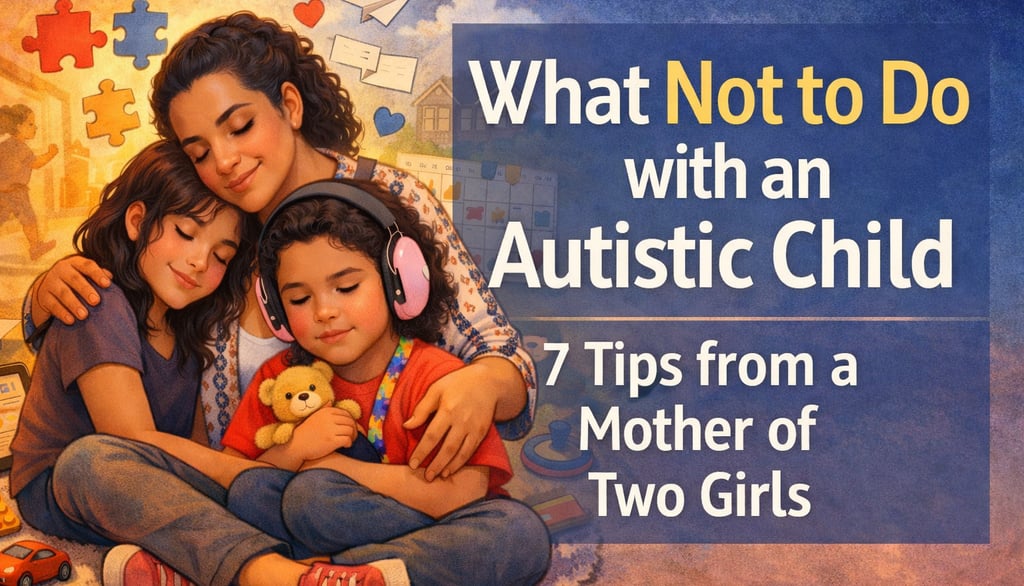
What Not to Do with an Autistic Child: 7 Tips from a Mother of Two Girls
A personal and practical guide about what not to do with an autistic child, written by a mother of two girls with different support levels (2 and 3). This article shares real-life mistakes, lessons learned, and strategies to support autistic children with empathy, structure, and respect.
Fabiana Pereira
2/13/20267 min read
The pain of learning by making mistakes
When I received the autism diagnosis of my daughters, my mind was flooded with questions:
“How can I help them? What will their future look like? Will they have friends?”
These doubts are normal. As parents, we want to protect, prepare, and make sure the world is kind to our children. But the world is not always kind. And when you discover that your daughters are on the spectrum, with different support levels (2 and 3), different challenges, and very specific needs, the fear becomes bigger.
In the middle of my desperation to be the support they needed, I made mistakes. Mistakes that brought stress, unnecessary meltdowns, and deep guilt. I am not writing this to romanticize our journey. There is nothing romantic here. There is love, constant adjustments, and the reality of a world that still lacks knowledge and empathy.
I share my mistakes because maybe you can learn without having to go through the same pain.
1. Don’t let her believe autism is something bad
Many autistic children grow up believing there is something “wrong” with them. This happens because the world still reacts with pity, ignorance, and comparison.
My older daughter received her diagnosis at 17 years old, years after her younger sister, who is level 3 autistic and non-verbal. What should have been a moment of clarity turned into fear. The first thing she said was:
“Don’t tell anyone.”
She had seen how people reacted to her sister’s diagnosis — comments full of pity, different looks, silent judgment. She could not understand how she could share the same diagnosis while being so different.
That is when I understood something important: inside the spectrum there is no hierarchy of pain. There is no “more” or “less” autistic. There are different needs. And all of them are valid.
I do my best to show her that autism does not define who she is. I explain that many negative reactions come from fear or lack of knowledge. Building a positive view about herself is a continuous process. But it is essential.
2. Don’t make tasks complicated
I learned, many times in the hardest way, that simple tasks for us can be overwhelming for an autistic child.
If I told my older daughter “clean the living room,” she would feel confused. She did not know where to start. When I corrected something that was left undone, she would answer in frustration:
“You didn’t say that before!”
And she was right.
I started breaking tasks into small steps. I created detailed lists so she could check each completed step. The result was surprising. She not only did it better, but with incredible precision — many times better than I would do myself.
With my younger daughter, the support needed to be even more structured. I use short sentences:
“Take the toothbrush.”
“Put the toothpaste.”
“Brush the bottom part.”
“Now the top.”
This method may seem slow, but over time these instructions become habits, and the task becomes part of her routine.
Adapt communication to your child’s needs. Use lists, pictures, or step-by-step guides to avoid sensory overload and improve understanding. The clearer the process, the more comfortable the child will feel.
And here is something important: sometimes people look at a level 1 child and say “she is independent,” or look at a level 3 child and say “she needs more.” The truth is that each one needs support at her own level. Not comparing is a constant exercise.
3. Don’t suddenly change the routine
Routine is the anchor that brings calm to many autistic children. Any unexpected change can lead to sensory overload, meltdowns, difficulty sleeping, and anxiety.
Even for my older daughter, where changes are more manageable, she still struggles to accept them. She can adjust, but she needs time. My younger daughter has more difficulty.
During school holidays, my younger daughter insists on wearing her school uniform. Even after I explain that there is no school, her body looks for the familiar pattern.
This creates resistance, discomfort, and sometimes a crisis.
I realized the confusion comes from the lack of predictability. For her, uniform means safety.
I started anticipating changes with simple strategies. At breakfast:
School days → ham and cheese sandwich.
No school days → bread with butter or mayonnaise.
This small detail helps her understand that the day will be different.
Changes need to be prepared in advance, using simple explanations, visual calendars, and planning. And even then, each daughter reacts differently. The older one can adjust, but she needs time. The younger one needs much more predictability.
4. Don’t speak in metaphors
My older daughter understands everything in a literal way.
One day, in the middle of an argument, I said:
“You have a sharp tongue,”
She immediately looked at me confused and asked:
“What do you mean?
My tongue is normal.”
My father is religious and always used expressions from the Bible, like:
“If the mountain does not go to Mohammed, Mohammed goes to the mountain.”
I grew up hearing this. But when I used it with my daughter, I realized how much confusion it caused. Now, I try to avoid them as much as possible.
She, now an adult, created a list to memorize the meaning of some expressions. Sarcasm is also difficult. I have seen her deeply hurt because she did not understand that someone was “joking.”
And the most painful part is when people who know about her difficulty use sarcasm to laugh at her.
Learning to communicate with more clarity and honesty with my daughters revealed an incredible depth in our relationship. I realized that simplifying my language is not only necessary for them, it is also a way to create more authentic bonds. Avoid metaphors and sarcasm. Encourage family and friends to do the same, especially in important conversations. And whenever necessary, stay close to explain or translate expressions.
5. Don’t yell or rush them
As a mother, I know how difficult it is to stay patient when daily life is challenging. My daughters test me, they know my limits and sometimes it feels like they make a point of pushing them. I have lost my patience more times than I would like to admit, which resulted in painful arguments and meltdowns that could have been avoided.
With my older daughter, I developed a simple but effective strategy: when I feel that I am about to lose control, I tell her, “Can we talk about this later, in 30 minutes?” This pause helps both of us calm down. Taking this time helps me think about how to manage expectations, and it also lets her know that the conversation is not being ignored, just postponed.
Now with my younger daughter, the approach is different. When I feel we are close to a meltdown, I offer something she likes to redirect her attention (a sensory toy, music, something that makes her laugh, or even a water balloon for her to throw). If possible, I put her in the bath. This calm moment not only helps her regulate herself, but also gives me space to breathe and recover my patience. Communication and patience are skills we develop little by little, but every effort is worth it.
I do not romanticize this. There are exhausting days. There is guilt. But every adjustment makes a difference.
6. Don’t try to stop stimming
Stimming is a powerful self-regulation tool for many autistic children. It is how they deal with sensory or emotional overload. Trying to stop these behaviors can be not only ineffective but also harmful, increasing anxiety or even causing a crisis.
Between the ages of 2 and 5, my younger daughter used to hit her head on the floor during meltdowns.
At first, I held her. I tried to stop it. It only made things worse. We both got hurt.
After professional guidance, I started doing things differently. When she began, I placed her in a safe and soft space. I sat at a safe distance and started playing with something she liked, like a spinner or building towers with blocks, without direct eye contact.
With time, she would stop crying, come closer, and join me.
I confess those moments took a piece of me. Not hugging her was painful. But I learned that when I interfered physically, the meltdown lasted longer.
Today, at 9 years old, this almost never happens.
Now, when she shows signs of overload, like flapping her hands or running in circles, we create safe alternatives. If she needs to run, for example, the teacher guides her to the hallway, where she can run and regulate herself without drawing attention to herself or her classmates. If the stimming is not dangerous, allow the child to do it. If necessary, redirect the behavior to a safer place or activity. Respecting this need is essential for the child’s well-being.
Every autistic person faces big challenges. All of them need support. Each one at their own level of need.
7. Don’t force eye contact
For many autistic children, maintaining eye contact is uncomfortable or even painful. While some people may interpret this as lack of interest or respect, it is important to understand that forcing this behavior can cause unnecessary suffering.
I remember repeating the words my mother used to say to me: “Look at me when I’m talking to you.” I said this to my older daughter many times, until I realized how much it affected her. It was hard for her to maintain eye contact, and still I insisted.
Eye contact can be painful. Forcing it does not teach respect, it teaches anxiety.
Today, I deeply regret it. I learned there are other ways to create connection and communication without eye contact. A smile, a gentle touch on the shoulder, or simply sitting next to her works much better for us. I learned to respect and understand my daughters’ limits regarding eye contact. I use alternatives, like talking while we walk or sitting side by side on the sofa. I also use written communication to make sure they feel comfortable and respected.
Respecting limits strengthens the bond.
Final Reflection
Being a mother of girls on the spectrum, with different support levels, is not an easy journey. There is no manual or magic formula. It is a real journey. Sometimes scary. The world still lacks knowledge and empathy, and comparison between support levels can be one of the most painful things we face.
But inside our home, I choose not to compare. I choose to adjust. I choose to learn.
I make mistakes. I learn. I adjust.
And I continue.
I hope my failures help you avoid unnecessary pain. I hope these lessons serve as practical reference, but also as a sincere hug from someone who lives this reality every day.
If this story touched you, share it with someone who is also trying to learn and understand autism. 💛