The Armour Nobody Sees — Why Autism Parents Seem Closed Off
Why do so many autism parents seem guarded and hard to reach? A mother of two autistic girls shares the real reason behind the walls we build, the invisible protection, trust, and emotional weight behind raising a neurodivergent child.
Fabiana Pereira
4/1/20267 min read
The Quiet Protection Behind Autism Parenting
It was Milena's graduation.
A day that should have been just about celebrating.
But a few weeks before, while everyone else was thinking about what to wear and where to have dinner, I was trying to solve a different problem: who would stay with Manuela?
Both my daughters are autistic and have ADHD. Manu is support level 3, nonverbal. At that time she was 5 years old. She can't tell me what happened. She has no sense of danger. She won't tell me if someone hurt her.
I live far from my family. I had only been in that city for 2 years. And that's exactly when something happened that I have never forgotten:
I left Manuela with someone I had known for less than six months.
I know. It sounds crazy.
I have friends of many years, members of my own family, who — if I'm honest — I would never leave alone with her.
And someone I had known for six months earned that trust.
How?
Why?
The Armour Doesn't Come From Nowhere
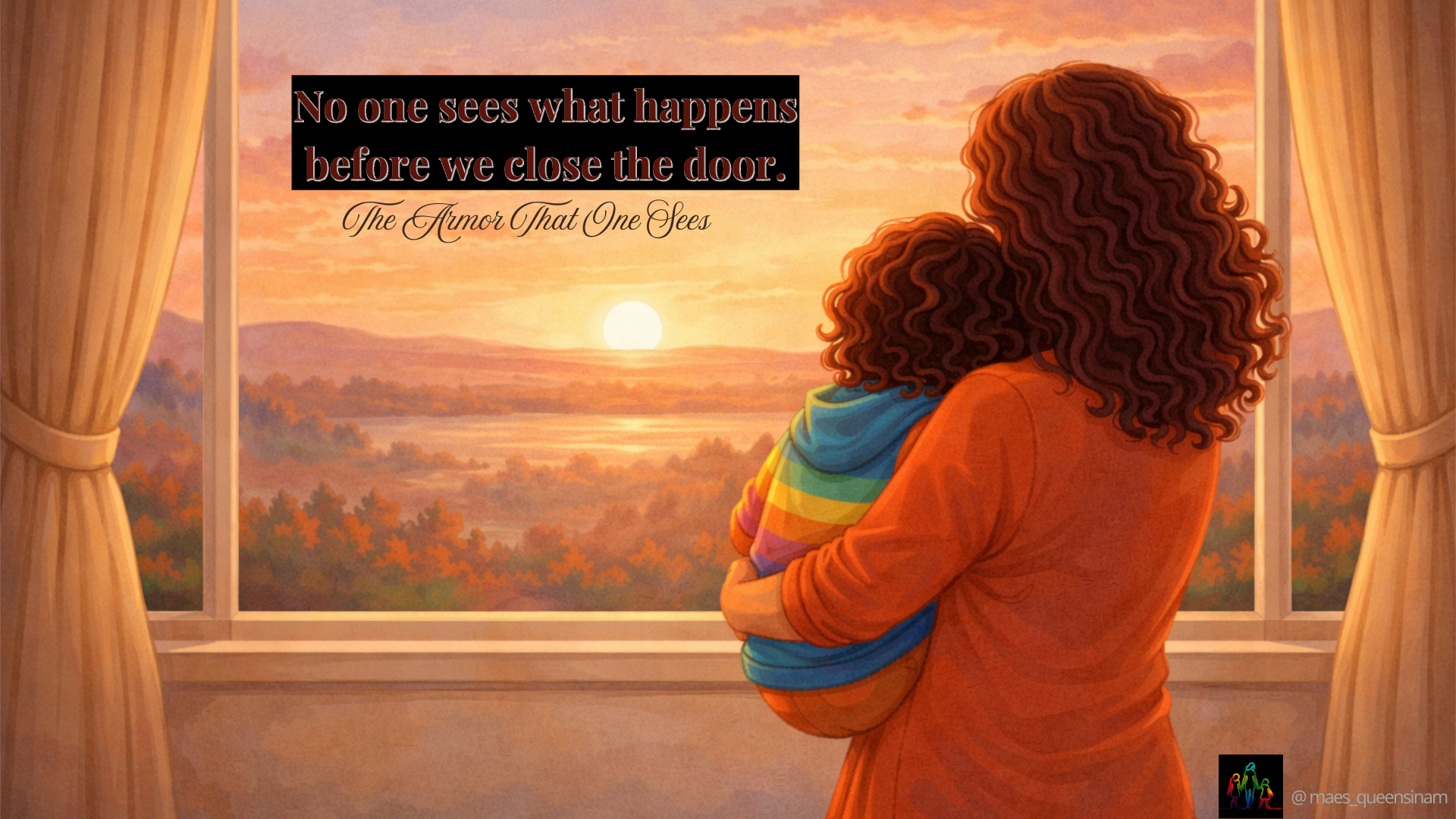
There is a quiet kind of loneliness in the lives of many parents of neurodivergent children.
It's not that we don't want to connect with people.
It's protection.
When you spend years being misunderstood — at restaurants, at schools, at family gatherings, at birthday parties — your body learns to get ready before anything even happens. You learn to think ahead before walking into any place. You learn to spot a judging look before it even fully forms.
And above all, you learn to protect your child.
It's not being paranoid. It's lived experience.
Every time someone asked "does she talk yet?" with that pitying tone.
Every time a child was left out at a party because "it's hard to play with her".
Every time a family member suggested, with the best intentions, that "maybe she'd be better in a special school".
Those things don't just go away. They build an armour.
And that armour has a job: it filters. It chooses. It protects the one who can't protect herself.
What I Watch For — Without Anyone Knowing
When I meet someone new, a quiet kind of watching begins.
It's not judging. It's reading.
I look for small signs, almost invisible ones, that most people don't even know they're giving:
The look on their face when Manu shouts.
How they react when she does hand flapping or runs in circles.
What they ask about her.
Because there are two kinds of questions.
The ones that focus on what she does not do: "she still doesn't talk?", "she never looks at you?", "she can't sit still?"
And the ones that focus on who she is: "what does she like?", "how does she communicate?", "what makes her happy?"
That difference might seem small.
To me, it's everything.
I also watch to see if someone comes close expecting Manu to react in a certain way. Whether they're waiting for a welcoming smile, a "thank you" for the gift, a hug at the right moment.
Manu doesn't work like that.
When you give her a present, she might look at it — or she might not. She might ignore it for days. And then one afternoon, out of nowhere, you find her exploring that thing with a focus and care that no one expected. She needed time to process that new object in her space.
Someone who gets that without me having to explain it… has already passed the test.
Today I want to talk about two very special women.
Mariene, the Flute, and Manu's Pace
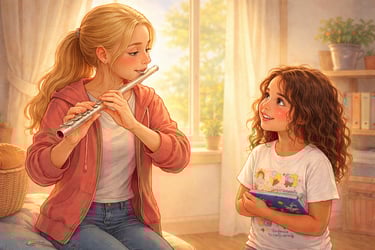
I met Mariene through music gatherings. She plays the flute beautifully, and sometimes we would all get together for choro music sessions — they would play and I would just listen. The musician in our family is my husband.
Manuela loves music.
From the very beginning, I watched how Mariene behaved around her. She never pushed for interaction. She never tried to teach, correct, or guide. When Manu would show up curious, moving closer to an instrument, sometimes reaching for the flute — Mariene would just smile and let her.
She welcomed her to join. In Manu's own time. In Manu's own way.
Over time, Manu got used to Mariene being around. Not in the way most people expect — not running in and shouting "auntie!". But in her own way: showing up quietly, sitting nearby, sometimes giving a surprise hug, sometimes climbing onto her lap without any warning.
That is huge.
Manu doesn't do that with just anyone.
Mariene earned that place without asking for it. And that is exactly why she earned a very special place in our hearts. She has all my admiration.
Celina and the Sofa Cushions
Celina came into my life in a way I didn't expect.
Our husbands got close through their shared love of music. She has two boys, a different lifestyle, a different background. At first, I wouldn't have guessed we'd become so close.
But then there was a moment that changed everything.
She invited us for lunch. A house full of people, everything beautifully set up and organised. I walked in already running through my plans: plan B, plan C, plan D. Less than one hour, and if Manu shows any sign of discomfort, we're going home.
I stayed right next to Manu the whole time.
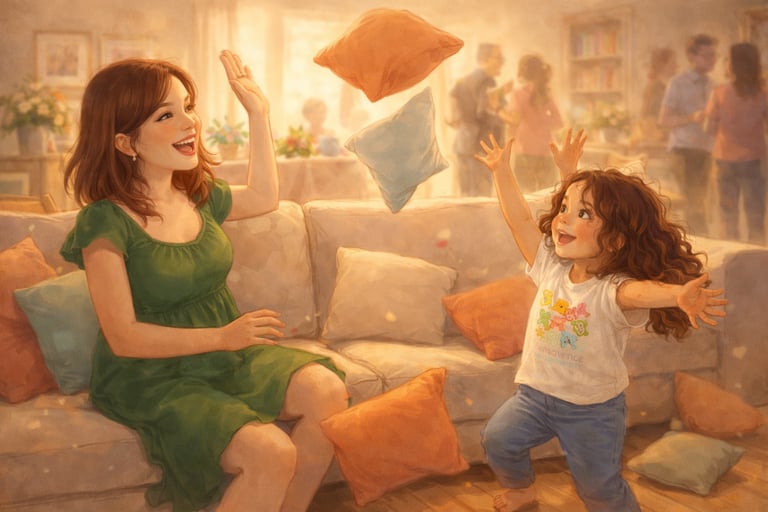
At some point, Manu started pulling the cushions off the sofa. I was about to ask her to stop when, suddenly, Celina appeared.
Beautiful, bright, without a moment's hesitation — she climbed up onto the sofa.
She helped Manu take the cushions off. Lay down next to her. Started playing.
No holding back. No looking at me for permission. No "look at me being so good about this" expression on her face. She simply stepped into Manu's world like it was the most natural thing in the world.
That broke me open.
It wasn't a big gesture. It was a scene of just a few minutes.
But those were the minutes that told me everything I needed to know.
Months later, when I needed to go to Milena's graduation, I didn't even have to finish the sentence.
Celina offered.
No holding back. No questions full of worries. No "but what if she..."
She stayed alone with Manu.
Celina is the only person outside the family who has ever been alone with Manuela.
Amazing, isn't it?
What Mariene and Celina Have in Common
When I think about these two women, I see a pattern.
Neither of them tried to fix Manu.
Neither of them looked at her with pity, with fear, or with that uncomfortable kind of curiosity from someone who has never been close to autism before.
Both of them did something that is simple and rare at the same time:
They saw her as a child first.
Not as "an autistic child". Not as a challenge. Not as a lesson in diversity. As a child. With things she loves, with her own presence, with her own way of being in the world.
On top of that, both of them:
→ Came close without waiting for anything back. They didn't expect Manu to receive them in any particular way. They just showed up, stayed nearby, and waited for her time.
→ Didn't ask questions that make you feel small. Never "she still doesn't do that?" They asked what she liked. What caught her attention. How she showed things.
→ Didn't have expectations. When Manu ignored them, they didn't show disappointment. When Manu surprised them with a hug, they received it without making a big deal.
→ Treated the flapping, the sounds, and the movement as part of her — not something to be fixed or commented on.
→ Talked to her as if she would answer. Because Manu understands. She sees, she feels, she knows who truly likes her and who is afraid of her. She knows.
The Armour Has a Price Too
I'm not going to make this sound nicer than it is.
This armour, as necessary as it is, also costs something.
There are friendships that were lost because I didn't know how, or couldn't find a way, to let people in.
There are people who maybe wanted to get closer but gave up because I was too closed off.
There are invitations I said no to out of fear — fear of the chaos, the explaining, the judging.
And from inside the armour, it's hard to know when the fear is keeping you safe and when it's just keeping you alone.
But I also know this: that same armour kept us away from situations and people that could have caused real harm. To my daughters and to me.
So I'm not here to say the armour is wrong.
I'm here to say it exists. That it has a reason. And that anyone who wants to be part of an atypical family's life needs to understand that — and be patient enough to wait for it to open.
What You Can Do Differently
If you have a neurodivergent child in your life — a friend's child, a classmate of your child, a nephew, a grandchild — and you want to truly connect:
Don't ask questions about what the child can't do.
Ask what they love.
Sit nearby without expecting them to interact.
Don't show fear or discomfort with their movements and sounds.
Talk to them as if they will answer — because they understand far more than you might think.
And above all: see them as a child first.
And if you are a parent of a neurodivergent child and you recognised yourself in this story:
Your armour makes sense.
You are not antisocial. You are not difficult. You are not overreacting.
You learned, in the hardest way possible, how to protect the person you love.
And when the right person shows up — someone who sometimes arrives in six months what others don't manage in decades — you will know.
Just like I did.
💜 Do you carry this armour too?
If this topic raised questions for you or if you would like to suggest other subjects for me to write about, you can find me on my personal Facebook profile. Tell me in the comments — and share this with another mum who needs to know she is not alone.