Raising an Autistic Child: The Invisible Adaptations Parents Make Every Day
Raising an autistic child often involves invisible daily adaptations. This personal story explains sensory seeking behaviour, autism parenting challenges, and the hidden work many parents do every day.
Fabiana Pereira
3/12/20265 min read
Things I Hide Every Day and Almost No One Notices
After six years away, I finally went back to my parents’ home with my girls.
It was a long-awaited trip.
Six years is a long time.
My parents were eager to see Manuela and Milena growing up close, to experience simple moments that until then had only existed through video calls.
When we finally arrived, everything felt perfect.
The last time they had seen Manu in person, she was three years old.
Now she was nine.
Six years change a lot of things.
Especially when you live the reality of autism.
When we arrived, everything was joy.
Long hugs.
A full table.
Conversations that stretched late into the night.
That deep feeling of finally being home.
But a few days later, something strange started growing inside me.
A constant tension.
A quiet fear that something could go out of control at any moment.
And the most confusing part was that I couldn’t explain where it was coming from.
I should have been happy.
I was with my family.
But every day I woke up in a state of alert.
The house was full of love.
But it wasn’t our house.
Without realising it, I started changing small things around the house.
Almost invisible things.
I pushed a piece of furniture slightly to the side.
Put something away inside a cupboard.
Moved something out of sight.
Small things.
But many of them.
Because when you live with an autistic child, the world slowly starts reorganising itself around them.
I would think about space so someone wouldn’t trip.
I would think about a corner where someone might hit their head.
I would think about unexpected noises.
I would think about visitors arriving without warning.
I would think about things that could turn into meltdowns.
I would think about things that could turn into accidents.
And all of this happened almost without awareness.
It was automatic.
Because in my house, everything has already been adapted over the years.
But there… no.
There it was a normal house.
A beautiful house.
A house full of love.
But it wasn’t a house adapted for an autistic child.
And that’s when I realised the weight of something that is rarely spoken about.
The weight of invisible adaptations.
Small things that become part of the routine of an atypical mother.
So natural that many times we don’t even notice them anymore.
Like eggs.
In my parents’ house, they stay in the fridge.
Like in any house.
But in my house, eggs are hidden on high shelves.
Covered.
Out of sight.
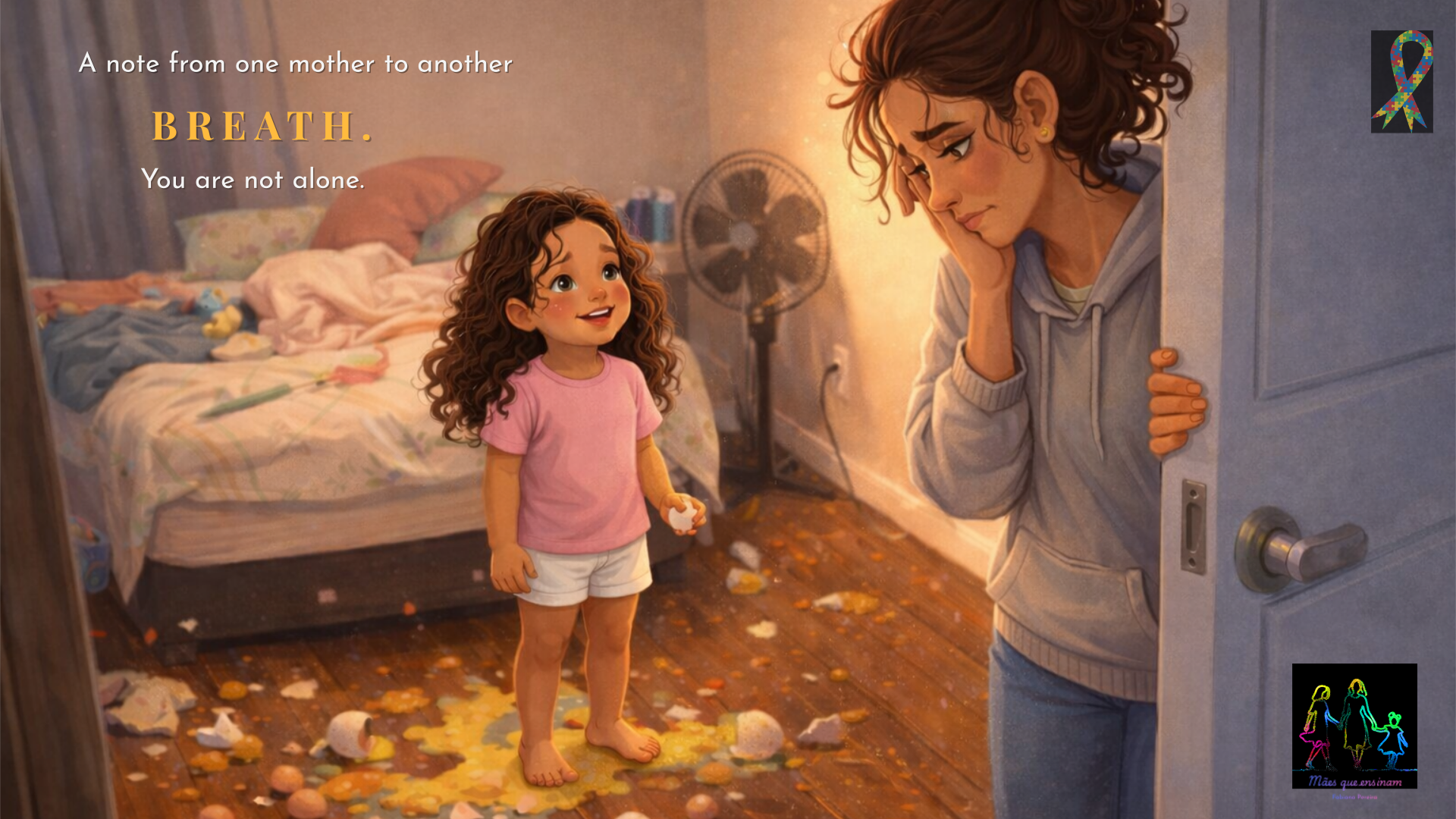
Because for Manuela, eggs are not just food.
They are a sensory experience.
Once she broke more than a dozen eggs on the bedroom floor.
Spread them on the walls.
On the mirror.
I spent weeks cleaning and trying to remove the smell from the room.
So now, automatically, I hide eggs.
Another thing is bathroom products.
Shampoo. Conditioner. Perfume. Make-up. Creams.
In many homes they stay visible, organised, decorating the bathroom.
But in my house they are stored away.
Locked.
They only appear when it’s time to use them.
Because if I forget…
They can be poured out.
Mixed together.
Spread across the floor.
Not because someone wants to make a mess.
But because many autistic children experience the world through sensations.
Some seek intense stimulation.
Textures.
Movement.
Strong smells.
The sound of something breaking.
The feeling of something running through their hands.
The visual of a liquid spreading across the floor.
This behaviour is known as sensory seeking — when the body looks for sensations to help the brain organise itself.
For many of these children, watching a liquid spread across the floor can be fascinating.
The sound of something breaking can be interesting.
The body searches for stimulation to organise itself.
To regulate the nervous system.
To understand its place in the world.
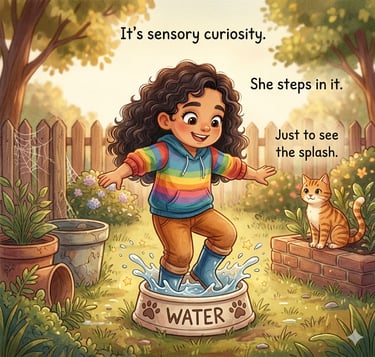
That’s why a puddle of water can be fascinating.
The sound of a splash can be irresistible.
It’s not mess.
It’s not disobedience.
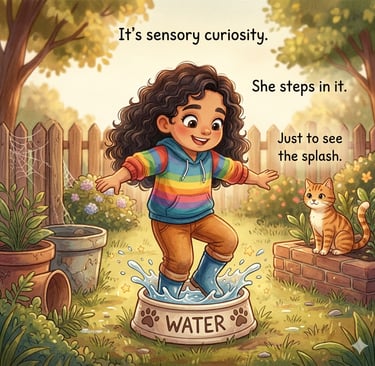
It’s sensory curiosity.
And that was exactly what made me place the dog’s water bowl in a hidden corner of the backyard.
Because if Manu sees something that looks like a puddle…
She steps in it.
Or throws something into it.
Just to see the splash.
And it was in that moment that everything made sense to me.
Someone asked:
“Why are you moving that?”
And while I was explaining…
I realised.
I was tired.
Very tired.
Tired of making hundreds of small adaptations every day.
Tired of predicting things that might never happen.
Tired of living in a state of anticipation.
Because the truth is that the sensory world of an autistic child can be unpredictable.
Sounds can feel much louder.
Lights can feel stronger.
Smells can feel intense.
And changes… can feel enormous.
The brain seeks predictability.
Safety.
Stable references.
Sometimes this appears in simple ways.
Sitting in the same chair every time.
Lying in the same spot.
Hanging upside down in a specific corner of the couch.
It may look like just a habit.
But many times it’s the body trying to organise itself.
To find balance.
When someone moves that chair…
It may seem like a small detail.
But to her brain it may feel like the whole world has changed.
The same happens with fear.
For many autistic children there is no small fear or big fear.
If something is frightening, the body reacts.
First the nervous system fires.
Then reason comes afterwards.
It could be an ant.
Or a snake.
The physical response may be the same.
The heart races.
The body goes into alert.
And in that moment explaining things doesn’t always help.
First the body needs to feel safe.
These are the things we learn by living.
By observing.
By making mistakes.
By trying again.
And slowly the world starts being adapted.
Piece of furniture by piece of furniture.
Object by object.
Routine by routine.
Until one day…
these adaptations become invisible.
So invisible that even we forget they exist.
Until we leave our own home.
Some mothers organise the house to make it beautiful.
Others organise the house to prevent meltdowns.
That is what that trip showed me.
That atypical motherhood carries a silent weight.
The weight of observing.
Predicting.
Adjusting.
Adapting.
Not to control the world.
But to make it a little safer.
And maybe the hardest part is something else.
Not everyone understands immediately.
And sometimes, in the middle of exhaustion, we may seem harsh.
But many times people’s questions come from the same place as our adaptations.
Love.
They want to help.
They just don’t know how yet.
And maybe that’s why some of the smallest things — hiding eggs, putting detergent away, or moving a bowl of water — can be the difference between a calm day…
and a very difficult one.
Because in the end…
atypical motherhood is made of hundreds of small invisible adaptations.
Small things that almost no one sees.
But that hold up the entire world of a child.
If you also find yourself hiding eggs, moving furniture, or putting things away that no one else notices…
maybe you carry these invisible adaptations too.
And if today you feel tired…
you are not alone.
If this topic raised questions for you or if you would like to suggest other subjects for me to write about, you can find me on my personal Facebook profile. This space is for sharing, learning, and support among mothers.