PDA in Autism: When It Is Not Disobedience but Anxiety
Understand what PDA in autism is, how demand avoidance is linked to anxiety, and how to manage it in everyday life. This text reflects my experience as a mother, based on the professional guidance I received and the journey I have lived with my daughters.
Fabiana Pereira
3/2/20266 min read
When It Is Not “Disobedience”: Understanding PDA in Autism
Some time ago, during one of Manuela’s sessions with her occupational therapist (OT), I was explaining how my girls have a lot of difficulty completing tasks. Most of the time, I need to present the task in a disguised way, so it does not feel like an obligation.
I spend a lot of time talking about why something is important or trying to show how it can be fun to tidy up toys or start a simple activity.
I have to be very creative, like this:
Practical example – Activities with Manu
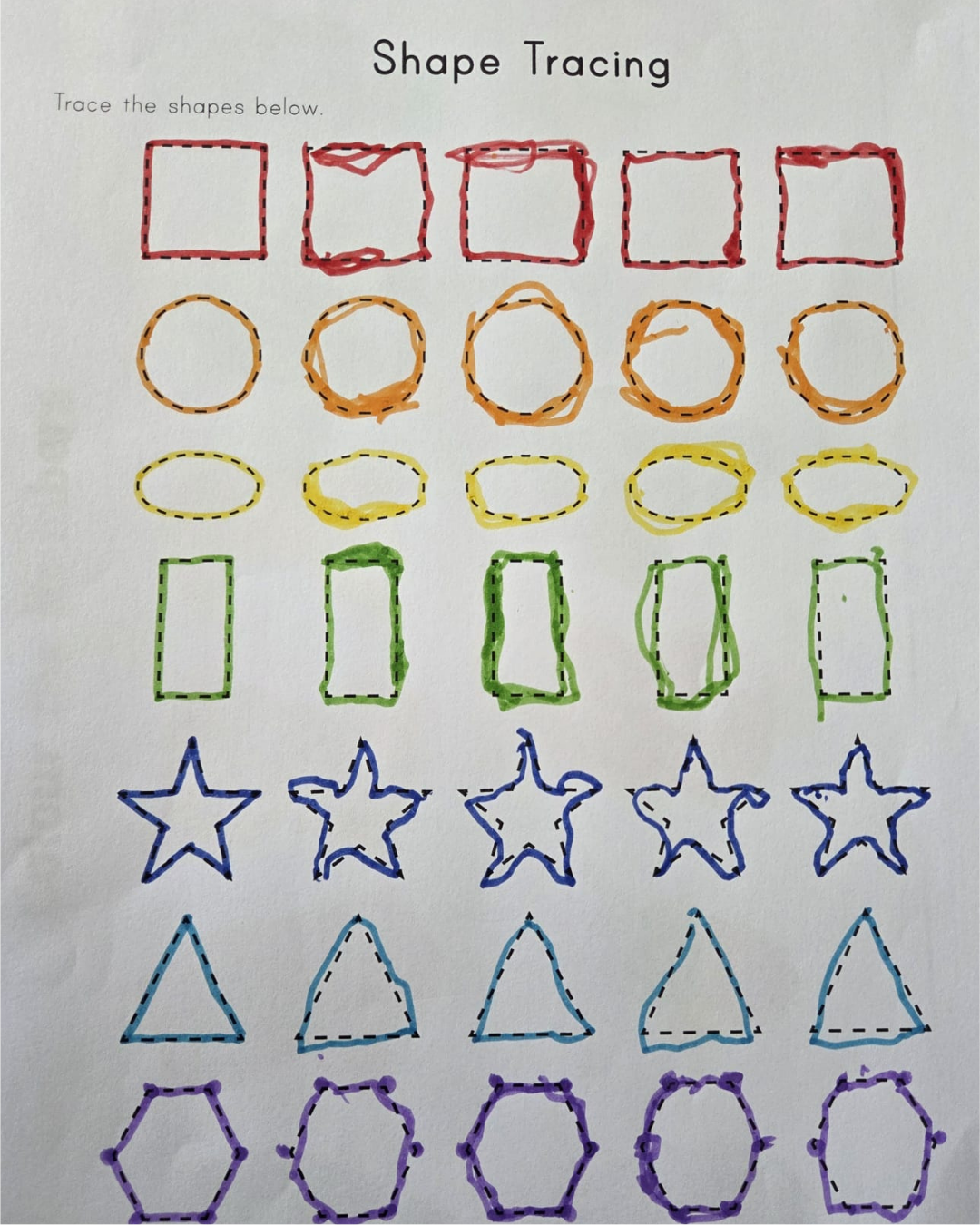
When I do writing activities with Manu, like following dotted lines, I cannot simply ask her to sit down and give her a pencil like most parents do.
Usually, I prepare a page where each line is a different colour, in rainbow order, and I show it to her. I place the coloured pens together and put her blank sheet next to mine, already coloured. Only then does she become interested and complete the activity.
I use this method for everything: maths, reading, writing. It does not matter what the school may say later.
What matters to me is that she is happy and completes the task without pressure, without running away, without me calling her a million times, and without meltdowns.
Because of all these strategies, the therapist asked me:
— Do you know what PDA is?
I had never heard of it.
When she explained that it meant Pathological Demand Avoidance, I admit my first feeling was not relief. It was panic.
Another acronym.
Another term.
Another thing to “add” to our list.
At that moment, I thought:
“What on earth, another thing to understand.”
But as she kept explaining, I started to realise something important: many of the strategies I was already using by instinct actually made sense within this profile.
My daughters are not unwilling to do tasks. It is not that I do not teach boundaries or that I overprotect them.
It is anxiety.
It is how their brain and body react to demands.
And it means there are new ways of teaching that we need to learn and adapt to.
Learning more about PDA changes a lot. As parents, we do many things by instinct, but giving it a name and understanding the science behind it brings clarity and comfort. It helps us understand that there is a reason for that behaviour, that we are not crazy, and that our children are not a “problem.”
So, what is PDA?
Autism is a spectrum with many colours, and one of those colours can be PDA (Pathological Demand Avoidance).
PDA is described as a pattern where a child avoids demands in an extreme way. Not only difficult tasks, but anything that feels like a demand — even something they usually enjoy.
Example – The park
Manu loves swinging at the park. When she arrives, she is very happy.
But when I say:
“Let’s go to the park,” she runs and hides.
Then the negotiation starts so she will go. This is very difficult because I have to convince her to do something I know makes her happy.
According to specialists, this avoidance can appear in different ways:
Creating distractions
Making excuses
Focusing intensely on something else
Negotiating
Withdrawing
Running away
Or even having a meltdown or panic reaction
Sometimes we think it is laziness or lack of willingness, especially when it is something they like.
But it is not intentional defiance.
It is a reaction to anxiety and internal discomfort.
It is not opposition. It is internal discomfort.
One thing that really stayed with me while learning about this is that resistance is often mistaken for:
Disobedience
Laziness
Lack of interest
Example – The mail
My older daughter never does anything without negotiating first.
She always has something more important to do. Many times, she locks herself in the bathroom for hours when I ask her to collect the mail from the mailbox.
There is always an excuse why she has not gone yet.
It drives me crazy.
But specialists explain that in the PDA profile, any external demand, something coming from another person, can create a very strong internal discomfort.
It is as if the body reacts before the mind does.
Even simple tasks, like:
Putting on shoes
Sitting at the table
Doing a school activity can create a block.
Example – The sandals before going out
My younger daughter learned how to put on her shoes. I was very proud of her.
She loves going for a car ride. So before we go to the car, I say:
Put your sandals on first.
She sits next to them, looks at the sandals, puts them aside, runs in circles. Sometimes she starts and then runs again, or lies on the sofa staring at the ceiling.
Then I have to remind her again:
Yay, let’s go for a car ride! Where are Manu’s sandals?
This cycle repeats a few times until she finally puts them on.
It is a simple task.
With a reward straight after — going in the car.
But even then, she tries to avoid putting on the sandals.
It is as if putting on sandals or collecting the mail feels like climbing a mountain — a long and exhausting task.
They can do it.
They know how to do it.
But they only do it when it feels like their choice.
They only complete something when they are internally motivated, and many times it needs to feel like their idea.
What is behind this?
Children on the spectrum, like my girls, already have cognitive rigidity and difficulty with flexibility.
When something changes suddenly, like the start of school holidays, taking a different road to the supermarket, even changing the colour of a toy box, or when a demand appears “out of nowhere,” it can create intense anxiety.
While many children socially learn that they need to wait their turn to use the swing, autistic children do not always process that social hierarchy in the same way.
They do not accept something just because someone said so.
They need the reason.
The logic behind the rule.
For example:
It is necessary to wait because he arrived first. There is an order. There is an agreement. There is a reason.
But in the PDA profile, the issue is not always understanding the rule. Often it is feeling that the waiting was imposed.
Just hearing “not now” can create strong internal discomfort.
I have experienced situations where the explanation was clear and logical, but the resistance still came.
Not because they did not understand.
But because the feeling of having no choice created anxiety.
It is not rebellion.
It is not bad manners.
It is not lack of boundaries.
What looks like disobedience may actually be a defence mechanism.
On the outside, it looks like control.
On the inside, it is discomfort.
When I started to see it through this lens, many situations with my girls began to make more sense.
It was not that they did not want to cooperate.
They needed to feel safe in order to cooperate.
Does this mean we should let them do everything their way?
Of course not. PDA does not mean no boundaries.
But it does mean that a very direct and very demanding approach can make resistance worse.
What works better for us at home is:
Giving choices
Negotiating
Building motivation
Avoiding direct confrontation
And I was already doing this without knowing the name.
I would turn:
“Tidy your room”
into
“Which part would you like to start with?”
or
“Let’s do this together for five minutes?”
Offering coloured pens to start an activity.
Inviting her to go to the park, but first we need to put on sandals.
It is not manipulation.
It is emotional survival.
An important note
PDA is not a formal diagnosis in the current diagnostic manuals. It is described by some professionals as a profile within the autism spectrum, characterised by a behavioural pattern associated with intense anxiety in response to demands. It is more commonly recognised in countries such as the United Kingdom and Australia, but it is still a topic of debate in other parts of the world.
It also does not mean that every autistic child has this profile.
But recognising this pattern can help us better understand behaviours that, for a long time, were called:
Tantrums
Stubbornness
Manipulation
When we understand that anxiety may be the root, our posture changes.
And when our posture changes, the result changes too.
What did I learn from this?
I learned that increasing pressure almost always increases resistance.
I learned that direct confrontation creates escalation.
I learned that when I reduce demands and increase safety, cooperation appears.
And most importantly:
Not every opposition is defiance.
Sometimes it is fear.
If you have ever felt that your child “fights against everything,” maybe it is not lack of boundaries.
Maybe it is anxiety.
And anxiety needs safety before demands.
I share here my perspective as a mother, based on my experience and what I have learned throughout our journey.
If this text made sense to you, share it with another mother who is also trying to understand the journey of being a neurodivergent parent. 💛
If this topic raised questions for you or if you would like to suggest other subjects for me to write about, you can find me on my personal Facebook profile. This space is for sharing, learning, and support among mothers.